Disclaimer

Showing posts with label Personality. Show all posts

Thursday, September 24, 2015

The Hero of the Battle of Dograi - Lieutenant Colonel Desmond Hayde-Maha Vir Chakra

Lieutenant Colonel Desmond Hayde was awarded the Mahavir Chakra, the second highest honour in battle, for winning one of the toughest battle battles ever fought by the Indian Army.
In a brilliant and gruesome assault, what he and his men achieved that September 50 years ago had never been seen before.
Archana Masih/Rediff.com salutes the maverick soldier';s soldier. 

IMAGE: Prime Minister Lal Bahadur Shastri greets 
Lieutenant Colonel Desmond Hayde in Dograi. 
Photograph: Kind courtesy Indian Army Facebook Page

In a cemetery in Bareilly, Uttar Pradesh, quietly rests a war hero that many may not know of -- a man born in Ireland, who led India in its bloodiest, yet finest, infantry battle in the 1965 Indo-Pak War.
It was an epic battle where 86 Indian soldiers died fighting a better fortified Pakistan army before the Indian flag could be raised in Dograi, on the outskirts of Lahore.
Led by Lieutenant Colonel Desmond E Hayde, whose Haryanavi was better than his clipped Hindi, the 3 Jat battalion of 550 men defeated an enemy which had double the number of soldiers.
They fought with guns, grenades, bayonets and bare hands, clearing every gulley, street, house and pill box (a concrete above-the-ground bunker) in an assault so courageous that it found its way into Haryanvi folklore.
For his personal courage and exemplary leadership, Lieutenant Colonel Hayde was awarded the Mahavir Chakra, the second highest honour in battle.
IMAGE: Lieutenant Colonel Hayde, who retired as a brigadier, painted by M F Husain. Photograph: Kind courtesy Indian Army Facebook Page
He is also perhaps the only soldier to be painted by the famed M F Husain on the battlefield. And it was during an address to his battalion, that Prime Minister Lal Bahadur Shastri, gave India one of its best known slogans ';Jai Jawan! Jai Kisan!
The colonel, who retired as a brigadier after 30 years serving the Indian Army, bequeathed the Husain painting, along with his medal, citation and typewriter to the Jat Regiment that he loved so dearly.
When he died two years ago at 87, he was buried in a cemetery near the regiment';s headquarters in Bareilly. Alongside him rests his wife Sheela, a Garhwali girl he had met in Bareilly as a young officer.
"He got a hero';s farewell with full military honours. His regiment worshipped him," says Colonel Kunwar Ajay Singh, who knew him for more than thirty years.
"He was a maverick. One of those old style army officers who was in a different league. He felt that he had to work with his men and be with his men to be a leader of men."
On the night of September 21, 1965 before his small battalion marched 8 kilometres from their trenches to Dograi, where the Pakistan army had entrenched itself, Lieutenant Colonel Hayde made only two demands of his men.
'Ek bhi aadmi pichhe nahin hatega! (Not a single man will turn back!)';
The second: 'Zinda ya murda, Dograi mein milna hai! (Dead or alive, we have to meet in Dograi!)
He warned his men against retreating. ';Even if all of you run away, I shall continue to stand on the battlefield alone,'; Rachna Bisht Rawat writes in her must read book on the men and battles of the war -- 1965, Stories from the Second Indo-Pak War.
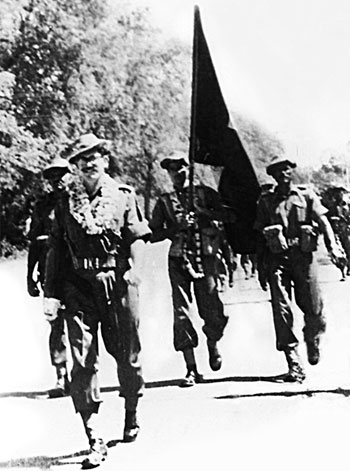
IMAGE: Lieutenant Colonel Hayde was the commanding officer of 3 Jat, one of the highest decorated regiments of the 1965 War. Photograph: Kind courtesy Indian Army Facebook Page
With just a single battalion, the daring commanding officer defeated the enemy battalion, which was supported by a tank squadron and one more battalion.
For what they accomplished that night, 3 Jat received three Mahavir Chakras, four Vir Chakras and seven Sena Medals.
"Brigadier Hayde never spoke about the Maha Vir Chakra or the Battle of Dograi. He thought of it as a job he had to do and he did it," says Colonel Singh, the managing director of a school which is run on the property bequeathed for the purpose by the brigadier in Kotdwar, Uttarakhand.
"He never even travelled on a free ticket that the government grants (for winners of gallantry medals). He was a rough, rugged, tough, guy for whom every day of life was the Indian Army."
Later this week, the school will be renamed Hayde Heritage. His three sons, one of whom retired as a lieutenant colonel from the Indian Army, will arrive from the UK and Canada to attend the ceremony.
The son of Anglo Indian parents whose father worked for the Railways, Brigadier Hayde';s rules in life were very simple, and embibed from the motto the Indian Military Academy had sent him out with:
The country comes first, your men come second and self comes last.
 "I have seen senior officers -- almost all have goals of self career progression -- but here was a man who had no iota of self," says Colonel Singh, who was encouraged and coached by Brigadier Hayde to join the Indian Army.
"That is the reason that even after he passed away in 2013, men from his regiment still call. He always thought of how the army and the lives of jawans could be improved, writing letters to the officials, the army chief, his own regiment etc."
Even in his 80s, if he was invited for an army function, he would call his gaadiwala (a hired car that he often used for outside travel) and set course.
Brigadier Hayde was no ordinary soldier, like so many other extraordinary men who fought so bravely in that month of September, 50 years ago.
Heroes like Havildar Abdul Hamid, Colonel A B Tarapore, Major Ranjit Dayal, Colonel Salim Caleb, Squadron Leader A B Devaiyya and many others -- men who need to be remembered but rarely are.
Ordered to breach the Ichogil canal, a deep and wide reservoir in Pakistan that ran parallel to the boundary, Colonel Hayde';s battalion first took Dograi on the night of September 6-7.
It was for this action that he won the Mahavir Chakra, announced on the battlefield itself.
But 3 Jat had to fall back because rest of the units detailed to support them in the offensive, could not reach in time because of lack of information. Colonel Hayde and his men stood their ground alone till ordered by the brigade headquarters to retreat.
The miscommunication resulted in the removal of a major general, while 3 Jat had to wait in bunkers 8 kilometres behind enemy lines till they got the next orders for launching an assault on Dograi.
The wait was almost two weeks. By then Pakistan had converted Dograi into a fortress.
IMAGE: Lieutenant Colonel Hayde is awarded the Mahavir Chakra from President Dr S Radhakrishnan. Photographs: Kind courtesy Indian Army Facebook Page
It was in this scarred backdrop, that Colonel Hayde and his troops were given the task of re-taking Dograi. And they did -- company by company, combat by combat, inch by inch -- in a gruesome battle in which one fifth of the battalion was killed.
The death count on the opposite side was nearly 300.
In a blog post, many years later, an army officer referred to what Colonel Hayde had told a correspondent when asked what makes soldiers fight such gruesome wars.
';The colonel pointed to his second in command, Major Shekhawat and said: "Major Shekhawat fights because he holds nothing dearer than the respect and standing he enjoys in the eyes of his men, family, and community back home. His fear of losing that standing overcomes his fear of death."
"The men, of course, fight because Major Shekhawat fights."
Major Shekhawat retired as a colonel. He lost four of his fellow officers in Dograi that night.
IMAGE: Brigadier Hayde (wearing a hat) with children at the Heritage Academy, Kotdwar, the school that was established on land he donated. Photograph: Kind courtesy, 1965: Stories from Second Indo-Pak War by Rachna Bisht Rawat. Penguin-Random House. 
After his retirement in 1978, Brigadier Hayde moved to Kotdwar in the Garhwal hills, his wife';s hometown.

Till the end, he followed a very precise schedule. Having breakfast at 7 am, thereafter walking up to his study -- researching the history of the Jats, the 1965 and 1971 wars etc -- and eating supper by 7.30 pm.
"Our offices were adjacent," recalls Colonel Singh. "If I had to meet Brigadier Hayde, I had to take an appointment and I';ll be damned if I was late even by a minute."
"He was a man who sought no popularity. He could be blunt and at times was not taken well. For him, there was no grey. Only black or white."
The brigadier set up the ex-servicemen league in Kotdwar and readily helped people from hispaltan. He wrote a book on the Battle of Dograi and completed his memoirs, which is yet to be published.
"He used to come across as someone who was not too fond of kids or company, but started enjoying their presence on campus," says Colonel Singh.
"His other passion was stray dogs. He adopted so many of them. In fact 2, 3 of them would be in his bed."
The war hero remained a soldier right till his end, and battled skin cancer, like only a gallantfauji could. Sometimes, even surprising doctors with the way he went about life in spite of the virulent disease that was eating him away.
Exactly a month before he died, he circled September 25 on a calendar and hung it on the wall.
"He said, look September 25th will be my last day and I told him, ';Sir, what nonsense are you speaking';," Colonel Singh recalls.
"But he was absolutely right."
Two days after after winning one of the Indian Army';s toughest battles on September 23, 1965, the hero of Dograi passed away 48 years later.

There will be a ceremony to commemorate Brigadier Desmond Hayde and the golden jubilee of the 1965 war in Kotdwar this week. It will be worth our while that we salute this authentic Indian hero and the brave Indian soldiers who fought the Battle of Dograi, wherever we are.

Thursday, September 17, 2015

Before you question OROP for Armed Forces think of a martyr called Mohan Nath Goswami


By Bikram Vohra

Till yesterday I had no idea who Lance Naik Mohan Nath Goswami was. Then I read about the fact that this commando killed 10 insurgents in 11 days and then laid down his life when a bullet with his name on it found him.

He was killed in Kupwara district when Indian Special Forces in Kashmir exchanged heavy fire in the Hafruda forests.

And all I want to know is what is his family getting as compensation for his valour and how soon. Not that it’s any great solace to her right now, but just when will his widow, Bhavna, now in a Haldwani (UP) hospital out of shock, find the money flowing into her bank account? That’s a question nobody is asking and nobody answering in all the heat and dust over the historic OROP declaration last Sunday.

For a moment when you want to critique your armed forces think of Lance Naik Goswami. Forget the furore over whether the Nehru Memorial Library and Museum is a dynastic monument.

 Lance Naik Goswami.

Ignore the 11-day riot over a high society murder.

Snub that union minister who nattered on for no reason at all. Pay attention to the real Indian.

This is the sort of gallantry that makes it worthwhile to take that OROP deal and hand it on a silver platter to these glorious men and women of our armed forces. All 1.2 billion people should stand up and salute him...they make movies about people like this. That’s your soldier. Guts and Glory.

How many of our men went out and scored 10 hits in that many days and then went out again?

Imagine the mayhem those 10 terrorists could have engineered, if it wasn’t for this man. How many hundreds of lives have been saved by this incredible man?

So, as Mark Anthony said, who will do him reverence?

Where is our Defence Ministry and what are they offering as gratitude?

I have not seen any talk show lauding him. Nothing about his funeral. Give him the country’s highest award for valour now... once his commanding officer has confirmed the heroism there is no need to wait.

Lance Naik Goswami with his family.

Announce the ex gratia payment and ensure the nation that Lance Naik Goswami is the man of the hour.

Look into the eyes of his widow Bhavna and Bhumika, their seven-year-old daughter. And ask only one question:

When will his widow get her revised OROP pension? No more, no less.

http://www.firstpost.com/india/befojre-you-question-orop-for-armed-forces-think-of-a-martyr-called-mohan-nath-goswami-2425432.html

Thursday, August 6, 2015

Excerpts of an Interview of Mr PM Nair, IAS – Dr Kalam's Secy


A clear indication of the greatness of Dr APJ Abdul Kalam

DD Podhigai telecast an interview with Mr P M Nair retired IAS officer who was the secretary to Dr Kalam Sir, when he was the President. I summarise the points he spoke in voice choked with emotion. Mr Nair had authored a book titled "Kalam Effect". 
1. Dr Kalam used to receive costly gifts whenever he went as it is customary for many nations to give gifts to the visiting Head of state. Refusing the gift would become an insult to the nation and an embarrassment for India. So, he received them and on his return, Dr Kalam asked the gifts to be photographed and then catalogued and handed over to the archives. Afterwards, he never even looked at them. He did not take even a pencil from the gifts received, when he left Rashtrapati Bhavan.

2.  In 2002, the year Dr Kalam took over, the Ramadan month came in July-August. It was a regular practice for the President to host an iftar party. Dr Kalam asked Mr Nair why he should host a party to people who are already well fed and asked him to find out how much would be the cost. Mr Nair told it costs around Rs. 22 lakhs. Dr Kalam asked him to donate that amount to a few selected orphanages in the form of food, dresses and blankets. The selection of orphanages was left to a team in Rashtrapati Bhavan and Dr Kalam had no role in it. After the selection was made, Dr Kalam asked Mr Nair to come inside his room and gave him a cheque for Rs 1 lakh. He said that he is giving some amount from his personal savings and this should not be informed to anyone. Mr Nair was so shocked that he said "Sir, I will go outside and tell everyone . People should know that here is a man who not only donated what he should have spent but he is giving his own money also". Dr Kalam though he was a devout Muslim did not have Iftar parties in the years in which he was the President. 

3. Dr Kalam did not like "yes sir" type of people. Once when the Chief Justice of India had come and on some point Dr Kalam expressed his view and asked Mr Nair, "Do you agree?"/ Mr Nair said "No sir, I do not agree with you". The Chief Justice was shocked and could not believe his ears. It was impossible for a civil servant to disagree with the president and that too so openly. Mr Nair told him that the President would question him afterwards why he disagreed and if the reason was logical 99% he would change his mind.


4. Dr Kalam invited 50 of his relatives to come to Delhi and they all stayed in Rashtrapati Bhavan. He organised a bus for them to go around the city which was paid for by him. No official car was used. All their stay and food was calculated as per the instructions of Dr Kalam and the bill came to Rs 2 lakhs which he paid. In the history of this country no one has done it. Now, wait for the climax, Dr Kalam's elder brother stayed with him in his room for the entire one week as Dr Kalam wanted his brother to stay with him. When they left, Dr Kalam wanted to pay rent for that room also. Imagine a President of country paying rent for the room in which he is staying. This was any way not agreed by the staff who thought the honesty was getting too much to handle!!!.

5.  When Kalam sir was to leave Rashtrapati Bhavan at the end of the tenure, every staff member went and met him and paid their respects. Mr Nair went to him alone as his wife had fractured her leg and was bed ridden. Dr Kalam asked why his wife did not come. He replied that she was in bed due to an accident. Next day, Nair saw lot of police men around his house and asked what had happened. They said that the President of India was coming to visit him in his house. He came and met his wife and chatted for some time. Mr Nair says that no president of any country would visit a civil servant's house and that too on such a simple pretext.


I thought I should give the details as many of you may not have seen the telecast and so it may be useful.

Saturday, June 20, 2015

The inspiring story of India's blade runner : Major D.P Singh - The Bravest among Brave Soldiers of India

Some write ups on this soldier with indomitable spirit, contributed from various sources

He was blown apart by a mortar and left for dead on a Kargil battlefield. Now, he’s running marathons


Major D.P. Singh runs in the Delhi Marathon with the Indian flag.

A mass of bleeding tissue, broken bones and intestines ripped out. That was Major Devender Pal Singh when fellow soldiers carried him to the field hospital. A mortar bomb had landed close to him on a Himalayan battlefield, during the 1999 Kargil War on the India-Pakistan border. The army surgeon declared him dead on arrival and sent his wrecked body to a makeshift mortuary. But 25-year-old Major Singh was not ready to die.

The story of how he beat death sounds incredible when you see him today, full of vitality. Now known as the ‘Indian Blade Runner’, he has been running marathons for 16 years.

It was at the mortuary on the mountains that another doctor from the army hospital spotted life in him. The chances of survival for anybody caught within eight yards of a mortar bomb are close to nil. He was embedded with shrapnels, Wafer thin, bedridden and disabled, the Major drew upon the survival instincts and courage that had spurred him to dive to the ground when the bomb landed about a yard and a half from him. Quick thinking had saved his life, but he would now have to learn to live anew.

“This was the start of my second life,” he told YourStory on the sidelines of the India Inclusion Summit in Bangalore. So what if life would never be the same again? It never is anyway. He decided not to think of his battered body as a disability. He looked upon it as a challenge, instead.

He stayed in hospital for almost a year. Hardly anyone believed he would ever walk again. But he thought, “Why just walk? I want to run.”

Major DP Singh’s transformation into the Indian Blade Runner didn’t happen overnight. He was never a runner before the amputation. But, “I wanted to run to inspire myself to go beyond my injuries,” as told in YourStory.

Running with his prosthetic leg wasn’t just hard, it was excruciatingly painful. “I refused to crawl. Every time I fell, I took it as a test of perseverance. That way, it is easier to try again,” he recollected. His first prosthetic limb was better suited for sprints than long distance running. Nevertheless, however agonising it was, the Major was already running marathons when prosthetics specialists at Hanger Clinic in Oklahoma City chanced upon a video clip of him. They invited him over to fit him with a better prosthetic that allowed him the greater flexibility needed for long distance running.

Today, at 39, the Indian Blade Runner has run close to 20 marathons. When he runs, he doesn’t hide his artificial leg. Onlookers often drop their jaws and stare. That doesn’t bother him.

He is also a motivational speaker, inspiring amputees across India. He manages a support group called The Challenging Ones.

“I started this support group to inspire others in a similar predicament. Sports can help build confidence and help overcome the disability,” he said. “People like me are generally called physically challenged. But I believe we are ‘challengers’. The trauma of losing a part of your body is huge. Your family and friends cannot imagine life after amputation. The initial stage where the person realises that s/he has lost a limb is the most difficult. Peer support is crucial.”

His aim is to help amputees find life again. “Make the Challengers break all shackles of dependency and overcome fears of lack of mobility to live as they did earlier. There is no limit,” he says.

This Republic Day, YourStory salutes his indomitable spirit. Check-out his interview with YourStory below.

Journey from ICU to marathon- Major D.P. Singh 
(Delhi marathon Runner)


After completing my Commando course with an injured knee in 1998, I was on leave to undergo knee surgery for ACL tear. In Mar 99, I joined unit and straight away went on PP6 in Munawar Tawi area of 10 Div. I was still undergoing physiotherapy which I could never complete for the prescribed duration courtesy Op Vijay.

It started in the month of May and things got very hot in 10 Div area too. On the fateful day of 15th July 99, I came under firing of mortar and got severely injured. Profusely bleeding all over the body when I reached hospital I was declared dead by the surgical specialist. As the luck would have another doctor, Anesthetic, was present there at that moment, who had a look at me and could revive me.

Since then, till Nov 2009, it took me ten full years to regain my ability back for which I was famous among my coursemates in IMA as I use to be the first one to sleep in the outdoor classes and come back in first five, when sent on round the temple to sit and relax while others were still running.

It all started with my craze of going for Rally sports. During my army days also I was passionate about rally sports but could never get chance to explore that area much as I was denied entry into such adventures owing to my medical condition. Once out, I began to explore it more, however as its an expensive sport, I needed money and sponsors. It was the hunt for sponsors which forced me to prove my worth as an individual first, as whomsoever I met in this regard, frowned on me because of my physical status. During that period I came across the advertisement of Airtel Delhi Half Marathon to be held in Nov 09 and I enrolled for it.

Month of October in Delhi is neither cold nor hot, in a way, ideal to get up early and go for jogging. First day, I donned the jogging suit and went out on road,started with a normal walk for about 2 kms. Long way to cover in next 14 days but there was some spirit, spirit of proving my worth again, spirit of doing something worth after a long. And thus every day I started getting up early and started going for regular jogs.

Within few days, I was able to hop run for about 4 to 5 kms. Sweating out like this after about 9 yrs was a feeling of elation. The max upto which I went during practice session was mere 9 kms. I wanted to do about 14 to 15 kms but in between there were various challenges like, coming back late from office and not able to complete the sleep to get up early, upset stomach or some other commitments in which I went out of Delhi. Controlling stomach was biggest challenge as due to injury twice my stomach underwent laprotomy in order to remove the intestinal adhesion. But after consulting a doctor I had a medicine to ease out this trouble.

As I was not able to complete the mark of 14 km in practise so, I was not sure whether I should attempt the run or not, there was some element of confusion. But I guess its normal to have such doubt before any test because this only makes you give your best.

Though I had prepared myself by buying new jogging shoes which will give me better grip and cushion to my left foot, toe and heel but toe and heel had given me piercing pain many a times while practice session and intolerable pain while doing the first marathon.

Early morning on the day of marathon, I got up at around 4, cleaned my bowl well and had my daily diet of (anjeer, kishmiss, khazoor and badaam) first thing in the morning. Mind was still confused whether to go for run or sleep again. For about five minutes I was confused, then suddenly I made up my mind to reach at starting point at least before the half marathon starts and let things to happen on its own. That was perhaps the moment of Rubicon, because after that not going ahead with run never struck me. I reached there on venue and wore my chest number. Public was amazed to see a one leg guy getting ready but that was giving me strength rather. While I was standing next to gate in the holding area, I met a 75 yrs old guy with his friend. He was an athlete of his times and was there to run half marathon. I touched his feet and he wished me good luck for the run. That was the moment when even the iota of doubt I had at the back of mind also got washed away.

And rest is history now, since 2009, I have completed three consecutive half marathons at Delhi and Mumbai both. Amazingly, improving time by 15 min in every run. My present prosthesis has over lived its life of 5 yrs by more than double and it is giving me trouble since last 3 yrs but some how I could manage my runs without getting bogged down by even this restraint. I am now trying to get a new prosthesis specially designed for running purpose with an aim to explore marathons outside India too. The fact that Limca book of records has published my attempt as maiden attempt in India and thus a record has given me a further push to take it forward. 

The inspiring story of Major D P Singh


Top of Form
Bottom of Form
Geetanjali Krishna

 On July 15, 1999, a young major was grievously injured in Kargil during Operation Vijay. Surgeons declared him dead in the army hospital; then managed to save him after amputating his leg. Today, that same soldier has run 12 half marathons, a feat as miraculous as it is inspirational.
Every time he crosses that finish line, Major D P Singh doesn't merely win a battle against his beleaguered body -- he sets new standards of bravery and endurance for people like us.
"When I learnt I'd lost my leg, I told myself that this would be yet another challenge in my life," says Singh.
He endured 10 painful years of recuperation thereafter.
"I just couldn't get used to the sympathetic glances I used to get from people. After a while, I was desperate to change that," he says. Although in his earlier days he'd been more into rally sports, Singh decided to take up running.

Another Version of

The inspiring story of India's blade runner Major D.P Singh


Overcoming adversity.

It was July 8th 1999. India was taking on Pakistan in the Kargil War. Major D.P. Singh fought bravely, but was severely injured by a mortar fired from other side of the border. He was declared dead at the Army hospital, but another doctor saved him. Singh’s legs were amputated in order to keep him alive. 

He did not let his disability affect him as he took up running and wanted to be a part of the Delhi Marathon in 2009. That was how long it took for Singh to recover from his injuries. 

“When I learnt I lost my leg, I told myself that this would be yet another challenge in my life. I just couldn’t get used to the sympathetic glances I used to get from people. After a while, I was desperate to change that,” Singh said.

The training

The training schedule of Singh has been gruelling. It takes him close to two hours just to get ready and wear the prosthesis. “So to run at 5 am, I wake up at 3”, he says.

He initially hopped on his good leg and dragged the prosthetic leg. After months of practice, he was able to hop-run for about five kilometers. Singh was happy with all the hard work he put in. “Sweating out like this after so long elated me. Although it was slow going, but I managed to run two half marathons like this,” he said. The amazing part about the run was that Singh improved his timing by 15 minutes in each attempt.

Singh got to know about the fibre blade prosthetic from South African blade runner Oscar Pistorius. He has entered the Limca book of records for being the first Indian to run a half marathon with a blade. 

Indian army helped a lot

He attributes his success to the discipline he received in the Indian army. “I owe it all to my upbringing as a Sikh and training in the Indian army, which has given me the ability to convert adversity into opportunity”.

His goal is to run a full marathon. “When I was injured, I received blood from countless people of different castes, creeds and states. With the blood of India running in my veins, I feel I can do everything”, he concludes.